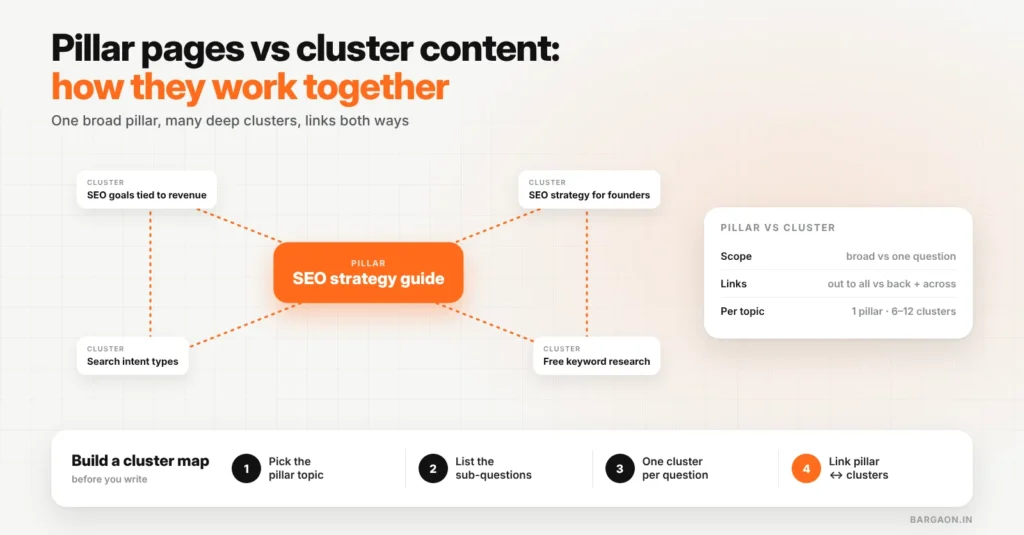
A pillar page covers a broad topic end to end and links out to cluster pages; each cluster page goes deep on one sub-question and links back to the pillar and to its neighbours. Together they show search engines and AI tools that you cover a topic fully, and they give readers a clear path from overview to detail. The pillar answers “what and why”; clusters answer “how, which and for whom”.
Key takeaways
- One pillar per topic, several clusters per pillar.
- Pillars stay broad; clusters stay narrow. Overlap between them causes pages to compete.
- Links are the glue: cluster → pillar, pillar → every cluster, and cluster → related cluster.
- Use the cluster map template below before writing anything new.
This is a short explainer for our topical authority and content clusters guide.
What each page does
| Pillar page | Cluster page | |
|---|---|---|
| Scope | Whole topic, overview to action | One sub-question in depth |
| Typical query | “SEO strategy” | “how to set SEO goals”, “SEO strategy for founders” |
| Length | Long, but skimmable | As long as the answer needs |
| Links | Out to every cluster | Back to pillar and to 2–3 related clusters |
| Updates | Every few months | When the sub-topic changes |
How they work together
One pillar, 6–12 clusters, links both ways
If two clusters would answer the same question, merge them.
On this site, our SEO strategy guide is a pillar. Posts such as what an SEO strategy is for founders and how to set SEO goals tied to revenue are clusters that link back to it and to each other.
Which existing pages should become clusters?
Our Content Refresh Prioritizer helps rank pages worth refreshing before you write new ones.
A simple cluster map template
| Page | Type | Main question | Links to |
|---|---|---|---|
| Email marketing guide | Pillar | How to run email marketing that sells | All clusters |
| Email deliverability basics | Cluster | Why do my emails land in spam? | Pillar, welcome series |
| Welcome email series | Cluster | What should new subscribers get first? | Pillar, deliverability |
| Email metrics that matter | Cluster | Which numbers should I track? | Pillar, welcome series |
Example (illustrative)
A Kolkata tea brand had 40 blog posts on tea, each standing alone. Grouping them under four pillars (green tea, Darjeeling, brewing, gifting), merging seven near-duplicates and linking each post to its pillar turned scattered posts into four clear topic hubs.
Common mistakes
- Pillars that try to rank for every sub-question and compete with their own clusters.
- Clusters with no link back to the pillar.
- Too many thin clusters; three strong ones beat ten weak ones.
The Bargaon view
Pillar and cluster is simply a tidy way to cover a topic fully and link it sensibly. Map before you write, keep each page to one job, and link both ways. Our content clusters guide goes further, and our SEO, AEO and GEO service can build your cluster map.
Want a cluster map for your site?
Share your top topic and existing pages; we will map pillar and clusters. See our SEO, AEO and GEO service.
FAQs
What is the difference between a pillar page and a cluster page?
A pillar covers a broad topic and links to cluster pages; each cluster covers one sub-question in depth and links back to the pillar.
How many cluster pages should a pillar have?
Usually six to twelve. Enough to cover the main sub-questions without creating thin or overlapping pages.
Can a blog post be a pillar?
Yes, if it covers the whole topic and links to deeper pages. Many sites use guides as pillars and blog posts as clusters.
Last updated: 12 November 2026. How we researched: Bargaon’s content planning method described above; the example is illustrative.
Digital Marketing & SEO Specialist
Himanshu Patni has spent more than nine years in search and growth marketing, watching discovery move from ten blue links to AI answers. His work brings SEO, AEO and GEO together with paid media and measurement as one system. At Bargaon, he writes about where search is heading and what businesses should do before the shift becomes obvious.