
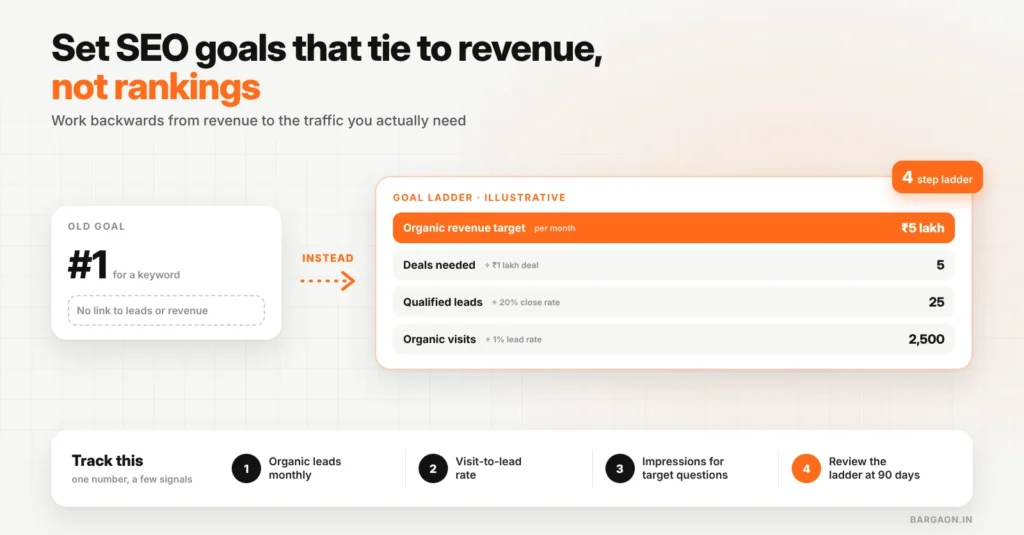
To set SEO goals that tie to revenue, start from the revenue you want from organic search and work backwards: revenue target ÷ average deal value = deals needed; deals ÷ close rate = qualified leads needed; leads ÷ conversion rate = organic visits needed. Rankings and traffic then become leading signals for that goal, not the goal itself.
Key takeaways
- “Rank #1 for X” is a tactic, not a goal. A goal has a business number in it.
- Use the four-step goal ladder below to turn a revenue target into a traffic target you can track.
- Track one business number monthly and two or three leading signals weekly.
- Set a review point at 90 days and adjust the ladder with real conversion rates.
This post turns decision 6 of our SEO strategy guide (“how will we know it worked?”) into numbers. If you have not written your strategy yet, read our one-page SEO strategy for founders first.
Why ranking goals mislead
A business can rank first for a phrase nobody buys from, and grow traffic while leads stay flat. Ranking goals also ignore AI answers, where buyers may see your brand without clicking. A revenue-linked goal fixes both: it does not care where the visit came from, only whether organic search produced pipeline.
The Bargaon SEO goal ladder
Work backwards from revenue
Each step divides by one real rate: deal value, close rate, then conversion rate.
A worked example (illustrative)
| Step | Input | Result |
|---|---|---|
| Organic revenue target | ₹60 lakh a year | ₹5 lakh a month |
| Average deal value | ₹1 lakh | 5 deals a month |
| Close rate from qualified lead | 20% | 25 qualified leads a month |
| Visit-to-qualified-lead rate | 1% | 2,500 relevant organic visits a month |
Now “2,500 relevant visits a month” is a traffic goal with a reason behind it, and “25 qualified leads” is the number that matters in the monthly review.
Work out the return on your marketing spend
Plug your deal value, close rate and costs into our free ROI calculator.
What to track, and how often
| Level | Metric | Check | Where |
|---|---|---|---|
| Business | Qualified leads or orders from organic | Monthly | CRM or store, by source |
| Conversion | Organic visit-to-lead rate on key pages | Monthly | GA4 key events |
| Leading | Impressions for target question groups | Weekly | Search Console |
| Leading | Target pages indexed and ranking on page 1–2 | Weekly | Search Console |
| Leading | Mention rate in AI answers | Monthly | Your prompt set |
Our GA4 setup guide covers key events, and the attribution guide covers matching leads in your CRM back to organic search.
Example (illustrative)
A Hyderabad IT staffing firm had a goal of “top 3 for staffing company Hyderabad”. After building the ladder, it found that phrase brought job seekers, not clients. It switched to client-side questions (“contract developers for 6-month project”) and judged progress on monthly client enquiries from organic, which became its only headline number.
Setting the rates when you have no data
- Deal value and close rate: use your last 6 to 12 months from any channel. Sales already knows these.
- Visit-to-lead rate: if you have no history, start with a cautious guess, then replace it with real data after 90 days.
- Time to results: organic work compounds slowly. Set the year-one ladder lower in the first two quarters and higher later.
The 90-day review
After three months, put real numbers into each step of the ladder. If visits are on track but leads are not, the problem is pages and offers, not SEO reach. If leads are on track but deals are not, it is lead quality or sales follow-up. The ladder shows which step is broken, so the next quarter’s work goes to the right place.
The Bargaon view
SEO goals belong in the same sheet as sales goals. Build the ladder once, track one business number monthly, and treat rankings as signals on the way there. When you are ready to plan the work behind the numbers, our SEO strategy guide walks through it, and our SEO, AEO and GEO service reports against exactly this kind of ladder.
Want your SEO goal ladder built for you?
Share your revenue target and sales numbers; we will send back a ladder with realistic monthly targets. See our SEO, AEO and GEO service.
FAQs
What is a good SEO goal?
One that names a business result, such as qualified leads or orders from organic search per month, with traffic and rankings tracked as leading signals.
How do I calculate how much organic traffic I need?
Divide your organic revenue target by average deal value, then by close rate, then by your visit-to-lead rate. The result is the number of relevant visits you need.
Should I still track rankings?
Yes, weekly, as an early sign of progress. Just do not treat a ranking as the goal, because it does not tell you whether the business grew.
Last updated: 9 November 2026. How we researched: Bargaon’s own goal-setting method described above; example figures are illustrative.
Digital Marketing & SEO Specialist
Himanshu Patni has spent more than nine years in search and growth marketing, watching discovery move from ten blue links to AI answers. His work brings SEO, AEO and GEO together with paid media and measurement as one system. At Bargaon, he writes about where search is heading and what businesses should do before the shift becomes obvious.