An SEO strategy is a short set of decisions about who you want to reach through search, which questions you will answer better than anyone, which pages you will build or fix to do it, and how you will know it worked. For most founders it fits on one page. If yours is a 40-slide deck of keywords and tasks, it is a to-do list, not a strategy.
Key takeaways
- A strategy is six decisions; tactics (keywords, blogs, backlinks) come after.
- What you focus on should change with your stage: pre-launch, early traction or scaling.
- In 2026 the same plan has to work for Google and for AI answers, so “be the clearest answer” matters more than volume.
- Use the one-page template below and the five questions to ask any agency.
This is the plain-English version of our full SEO strategy guide. Read this to understand what you are buying or building; read the guide when you are ready to do it.
What an SEO strategy is, and what it is not
| A strategy says… | A task list says… |
|---|---|
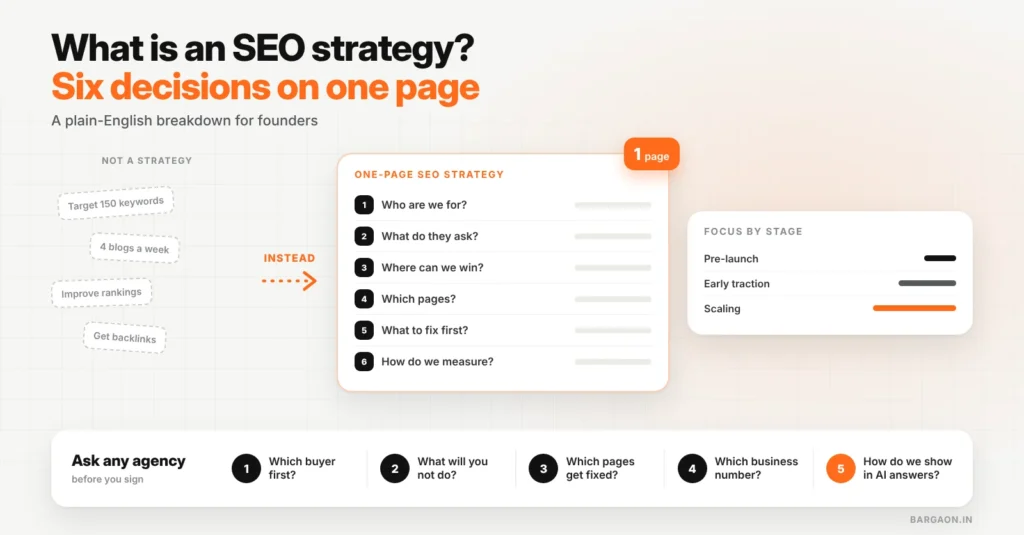
| “We will win searches from HR heads comparing payroll tools, because our product is cheaper to switch to.” | “Target 150 keywords.” |
| “We will not chase generic ‘what is payroll’ traffic this year.” | “Publish 4 blogs a week.” |
| “Success = demo requests from organic search, checked monthly.” | “Improve rankings.” |
Google’s own SEO Starter Guide is a good list of basics, but it cannot tell you which of them matter for your business. That choice is the strategy.
The one-page SEO strategy: six decisions
Answer these six, in this order
One line per decision. If you cannot write it in one line, you have not decided yet.
- Who are we for? One buyer type, in one sentence. “Mid-size manufacturers in Gujarat buying their first ERP” beats “businesses”.
- What do they search or ask? List the 20 questions buyers ask before they buy, in their words. Talk to sales; read support tickets. Our keyword research guide shows how to turn these into searches.
- Where can we realistically win? Pick the questions where big sites are weak or generic. A new site rarely wins “best CRM”; it can win “CRM for 10-person real estate teams in Pune”.
- Which pages answer them? Map each question group to one page: a service page, a comparison, a guide. One page, one job.
- What has to be fixed first? Speed, crawl issues, missing service pages. Fixes come before new content.
- How will we know? One business metric (leads, demos, orders from organic) and two leading signals (pages indexed, impressions for target questions).
See what your key page is missing
Run your main service page through our On-Page SEO Analyzer for a quick list of fixes.
What to focus on at your stage
| Stage | Focus most effort on | Leave for later |
|---|---|---|
| Pre-launch or first website | Clean site structure, one strong page per service, Google Business Profile if local | Blogs, link building |
| Early traction (some leads, under ~50 pages) | Comparison and “for [buyer type]” pages, answer-first FAQs, internal links | Broad “what is” content |
| Scaling (steady leads, many pages) | Topic clusters, content refreshes, digital PR, AI answer visibility | Re-doing the basics every quarter |
This split is our opinion from working with B2B and D2C sites, not a rule. The point is to do fewer things at each stage, well.
Example (illustrative)
A Kochi-based tour operator with a 12-page site was told to “start a blog”. Using the six decisions, it chose one buyer (families from the Gulf booking Kerala trips), wrote down 20 questions they ask on WhatsApp, and built five pages answering them, each with prices and sample itineraries. The blog waited.
How AI search changes the plan
Buyers now also ask ChatGPT, Perplexity and Google’s AI answers. The good news: the six decisions do not change. What changes is the bar for decision 4. Pages need a clear answer near the top, facts stated plainly (price range, locations, who it is for) and FAQs in buyers’ words, so AI tools can quote them. Our AEO guide covers this in detail.
Five questions to ask any SEO agency
- Which buyer and which questions are you targeting first, and why those?
- What will you not do in the first 90 days?
- Which existing pages will you fix before writing new ones?
- What business number will you report monthly, not just rankings?
- How will our pages show up in AI answers, and how will you check?
If the answers are vague, you are being sold tasks, not a strategy.
The Bargaon view
A good SEO strategy is short, specific and says no to a lot. Write the six decisions on one page, match the work to your stage, and measure leads or orders, not rankings. When you are ready to build it out, our SEO strategy guide goes step by step, and our SEO, AEO and GEO service can run it with you.
Want us to write your one-page SEO strategy?
Share your site and goals; we will send back the six decisions filled in. See our SEO, AEO and GEO service.
FAQs
How long does an SEO strategy take to show results?
Fixes to existing pages can show within weeks; new pages usually take a few months to earn steady traffic. Judge the plan on leads and leading signals each month, not on day-one rankings.
Do I need a blog for SEO?
Not at first. Most early-stage sites gain more from strong service and comparison pages. Blogs help once those pages exist and you have questions they do not answer.
Is SEO still worth it with AI search?
Yes. AI answers draw on web pages, and the same clear, specific pages that rank also get quoted. The work shifts towards clear answers and facts, not away from search.
Sources
- Google Search Central: SEO Starter Guide (checked 7 Nov 2026)
Last updated: 7 November 2026. How we researched: Google’s own SEO documentation plus Bargaon’s planning method described above.
Digital Marketing & SEO Specialist
Himanshu Patni has spent more than nine years in search and growth marketing, watching discovery move from ten blue links to AI answers. His work brings SEO, AEO and GEO together with paid media and measurement as one system. At Bargaon, he writes about where search is heading and what businesses should do before the shift becomes obvious.