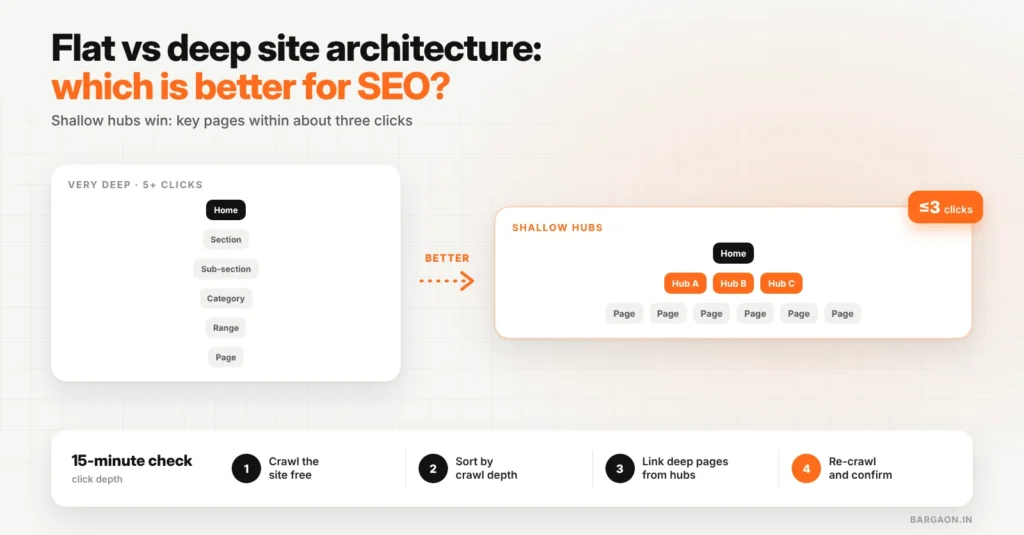
For most business websites, a fairly flat architecture works best: every important page should be reachable within about three clicks from the home page, grouped under a small number of clear hubs. A very deep structure buries pages where users and crawlers rarely reach them; a completely flat one (everything linked from the home page) gives no sense of topic or priority. The practical answer is a shallow hub-and-spoke structure.
Key takeaways
- Click depth matters more than URL folders. A page can sit in a deep folder but still be one click from a hub.
- Aim for key pages within about three clicks of the home page.
- Use hubs (service, category or topic pages) to group related pages and pass internal links.
- Check click depth in a free crawl before changing any URLs.
This is a quick primer for our site architecture and internal linking guide.
Flat vs deep, in one picture
| Structure | What it looks like | Problem |
|---|---|---|
| Very flat | Home page links to every page directly | No grouping; menus become long lists; no topic signals |
| Very deep | Home → section → sub-section → category → page (5+ clicks) | Important pages get few internal links and are crawled less often |
| Shallow hubs (recommended) | Home → hub → page, with links between related pages | Needs a little planning, but scales well |
Google’s SEO Starter Guide recommends grouping topically similar pages and linking pages in a way that helps people and Google find your important content.
The 3-click rule, and why it is a guide not a law
There is no ranking rule that says “three clicks”. It is a practical target: pages close to the home page usually get more internal links, are found faster and are easier for visitors to reach. For a 50-page service site, three clicks is easy. For a 20,000-product store, faceted navigation and category hubs do the job instead.
Check your key page’s structure
Our On-Page SEO Analyzer checks headings, links and structure on any page in seconds.
Recommended shape by site type
Home → hubs → pages, plus side links
Every page links up to its hub and across to 2–3 related pages.
| Site type | Hubs | Pages under each hub |
|---|---|---|
| Service business | Service categories | Individual services, industries, locations |
| eCommerce | Main categories | Sub-categories and products |
| Content or blog | Topic pillars | Articles in that topic |
| Local multi-city | City pages | Services in that city |
The 15-minute click-depth check
- Crawl your site with a free crawler (Screaming Frog’s free version covers up to 500 URLs).
- Sort by crawl depth. List any important page at depth 4 or more.
- For each, add a link from its hub or from a strong related page.
- Re-crawl and confirm the depth dropped.
Example (illustrative)
A Coimbatore pump manufacturer had product pages five clicks deep, behind “Products → Industrial → Range → Series”. Adding links to each series from three category hubs, and linking related models to each other, brought every product within three clicks without changing a single URL.
The Bargaon view
Do not restructure URLs to “flatten” a site. Fix click depth with hubs and internal links first; it is cheaper and safer. Our site architecture guide goes deeper, and our technical SEO service can map your structure for you.
Want a quick structure review?
Send us your site and we will list the important pages buried too deep. See our technical SEO service.
FAQs
Is a flat site structure better for SEO?
A shallow structure with clear hubs usually works best. Completely flat sites lose topic grouping; very deep ones bury important pages.
Does URL depth matter?
Click depth matters more than the number of folders in a URL. A page in a deep folder can still be one click from a hub.
Should I change URLs to flatten my site?
Usually not. Add internal links from hubs first. Changing URLs needs redirects and carries risk.
Sources
- Google Search Central: SEO Starter Guide (checked 11 Nov 2026)
Last updated: 11 November 2026. How we researched: Google’s SEO documentation plus Bargaon’s site structure method described above.
Digital Marketing & SEO Specialist
Himanshu Patni has spent more than nine years in search and growth marketing, watching discovery move from ten blue links to AI answers. His work brings SEO, AEO and GEO together with paid media and measurement as one system. At Bargaon, he writes about where search is heading and what businesses should do before the shift becomes obvious.