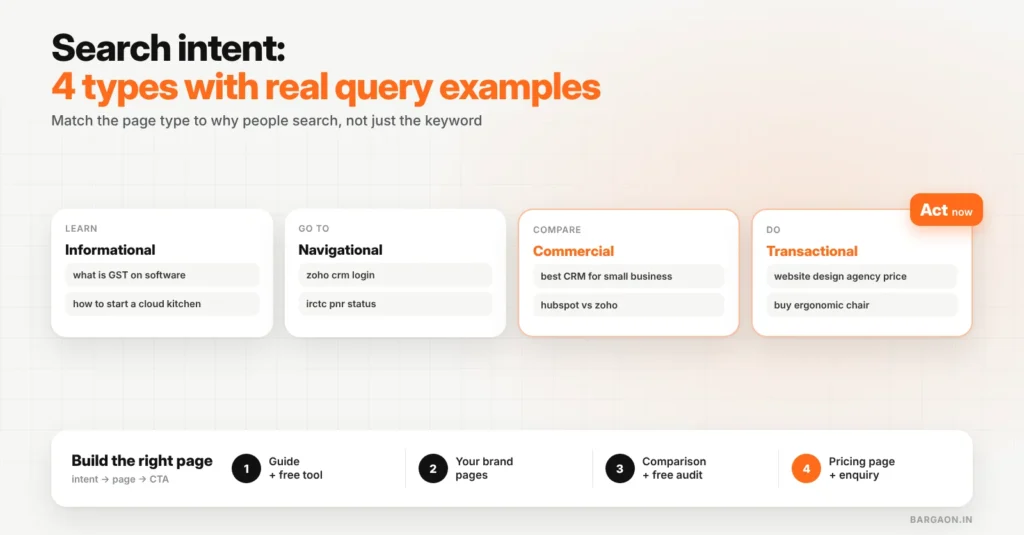
Search intent is the reason behind a search: to learn something (informational), to reach a specific site (navigational), to compare options before buying (commercial) or to act now (transactional). Matching the page type to the intent matters more than the keyword itself: a “what is” query wants an explainer, a “best X for Y” query wants a comparison, and a “X price” query wants a page where people can buy or enquire.
Key takeaways
- Four intent types cover most searches; many queries mix two.
- Check the live results page before deciding intent. Google already shows you what it thinks people want.
- Each intent needs a different page type and a different call to action.
- AI answers handle most informational queries, so commercial and transactional pages deserve extra care.
This is the quick version of the intent section in our keyword research and search intent guide.
The 4 types, with real query examples
| Intent | The searcher wants to… | Example queries |
|---|---|---|
| Informational | Learn or understand | “what is GST on software services”, “how to start a cloud kitchen” |
| Navigational | Reach a known site or page | “zoho crm login”, “irctc pnr status” |
| Commercial | Compare before choosing | “best CRM for small business india”, “hubspot vs zoho” |
| Transactional | Act now: buy, book, enquire | “website design agency jaipur price”, “buy ergonomic chair online” |
Google’s own Search Quality Rater Guidelines use a similar split of “know”, “do”, “website” and “visit in person” queries; see the rater guidelines PDF.
The 5-second results check
Before writing anything, search the query and look at the first page:
- Mostly guides and definitions? Informational. Write an explainer.
- “Best”, “top” and comparison pages? Commercial. Build a comparison or “for [buyer type]” page.
- Product, pricing or local listings? Transactional. Use a service, product or pricing page.
- One brand’s site dominates? Navigational. Unless it is your brand, move on.
Is your page matching its intent?
Run it through our On-Page SEO Analyzer for a quick check of title, headings and structure.
Intent → page type → call to action
Match all three, not just the keyword
An explainer with a “Book a call” button, or a pricing page with no price, both break the match.
| Intent | Page type | Natural next step (CTA) |
|---|---|---|
| Informational | Guide, explainer, FAQ | Related guide, free tool, newsletter |
| Commercial | Comparison, “for [buyer]” page, case study | Free audit, assessment, demo |
| Transactional | Service, pricing or product page | Enquiry form, call, WhatsApp, buy |
| Navigational | Your own brand and login pages | The task they came for |
Example (illustrative)
A Lucknow CA firm wrote a long blog for “GST registration fees” and wondered why enquiries did not come. The results page showed government pages and firms listing their fee upfront: the query was transactional. A short page with the firm’s fee, documents needed and a WhatsApp button matched the intent far better than the blog.
Mixed intent and AI answers
Many queries mix two intents, for example “best accounting software for freelancers” is commercial with an informational layer. Cover both: a short answer up top, then the comparison. Also note that AI answers now resolve many simple informational queries without a click, so your informational pages should lead somewhere useful, and your commercial and transactional pages should be the clearest on the web for your niche.
The Bargaon view
Intent is the cheapest SEO win most sites miss. Check the results page, pick the page type that matches, and give each page the next step its reader expects. Our keyword research guide shows how to group keywords by intent, and our SEO, AEO and GEO service can map your site against it.
Are your key pages matching the right intent?
Send us your top 5 pages and the searches you want them to win; we will tell you which ones mismatch. See our SEO, AEO and GEO service.
FAQs
What are the 4 types of search intent?
Informational (learn), navigational (reach a known site), commercial (compare before buying) and transactional (act now, such as buy or enquire).
How do I find the search intent of a keyword?
Search it and look at the first page of results. The types of pages Google shows, such as guides, comparisons or product pages, tell you which intent it has matched.
Can one page target more than one intent?
Yes, if the intents are close, such as commercial with an informational layer. Very different intents, like “what is” and “price”, are better served by separate pages.
Sources
- Google Search Quality Rater Guidelines (PDF) (checked 10 Nov 2026)
Last updated: 10 November 2026. How we researched: Google’s rater guidelines plus Bargaon’s intent-mapping method described above; query examples are illustrative.
Digital Marketing & SEO Specialist
Himanshu Patni has spent more than nine years in search and growth marketing, watching discovery move from ten blue links to AI answers. His work brings SEO, AEO and GEO together with paid media and measurement as one system. At Bargaon, he writes about where search is heading and what businesses should do before the shift becomes obvious.