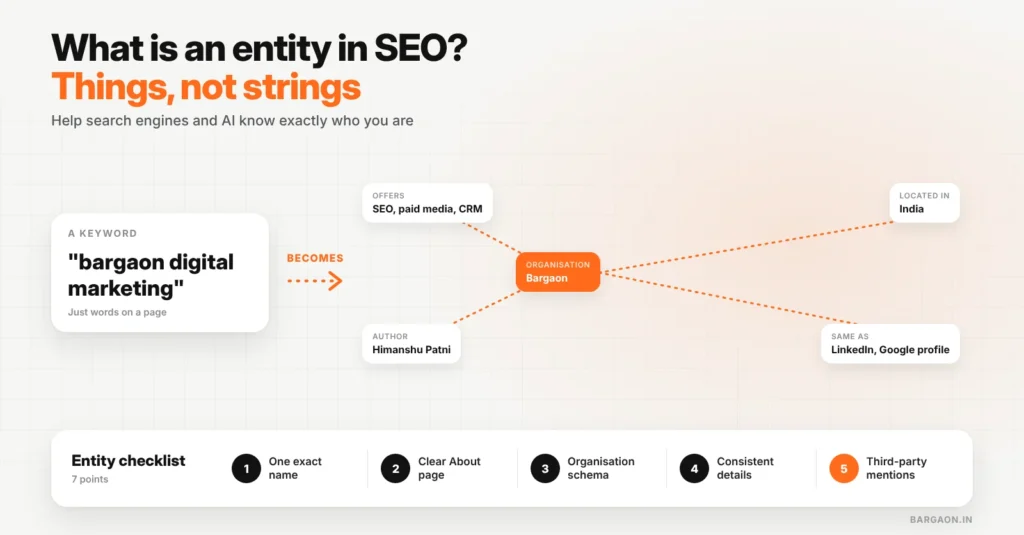
In SEO, an entity is a distinct, well-defined thing, such as a business, a person, a place, a product or a concept, that search engines can recognise and connect to facts. Google moved towards understanding “things, not strings” with its Knowledge Graph in 2012. For a business, being a clear entity means search engines and AI tools know exactly who you are, what you do and where, from consistent facts across your site and the web.
Key takeaways
- Keywords are words; entities are the things those words refer to.
- Search engines and AI answers rely on entities to decide who to show and what facts to state.
- Your business becomes a strong entity through consistent name, address, services and links across the web.
- Use the 7-point entity checklist below; most fixes take an afternoon.
This is the plain-English starting point for our entity SEO and structured data guide.
Keyword vs entity: a simple example
The word “Jaguar” could mean a car brand, an animal or a football club. Each of those is a separate entity. When Google introduced the Knowledge Graph, it described the shift as understanding “things, not strings” in its announcement. Search engines use context to decide which entity a page or query is about, and then connect it to known facts.
| Keyword view | Entity view |
|---|---|
| “bargaon digital marketing noida” | Bargaon (organisation) → offers SEO, paid media, CRM → based in India |
| “best CRM for small business” | CRM (software category) → products like HubSpot, Zoho → used by small businesses |
| “Himanshu Patni SEO” | Himanshu Patni (person) → writes for Bargaon → topics: SEO, AEO, GEO |
Why entities matter more with AI search
When ChatGPT, Perplexity or Google’s AI answers recommend a business, they need to be confident it exists, what it does and where. If your name, services and location appear consistently on your site, profiles and third-party pages, AI tools have something solid to state. If they conflict, you are easier to leave out or describe wrongly.
The 7-point entity checklist for a business
Make it easy to know who you are
Score 1 point for each item done. 6–7: strong. 3–5: fix the gaps. 0–2: start with items 1–3.
- One exact name. Use the same business name everywhere: site, Google Business Profile, LinkedIn, invoices.
- A clear About page. Who you are, what you do, where, since when, and who runs it, in plain sentences.
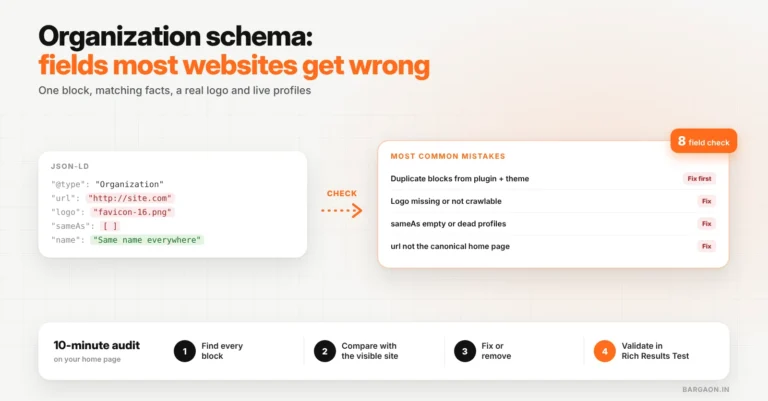
- Organisation schema. Mark up your name, logo, URL, contact details and
sameAslinks to your official profiles. Google’s structured data introduction explains how markup helps it understand pages. - Linked official profiles. LinkedIn, Google Business Profile, social accounts and directories should all link back to your site.
- Consistent name, address and phone. Old addresses and old phone numbers on directories create conflicting facts.
- Named people. Authors and leaders with their own short bios and profiles strengthen trust in the business entity.
- Third-party mentions. Industry lists, local news, partner pages and reviews that name you in context.
Generate your Organisation schema
Create clean JSON-LD for your business with our free Schema Generator, then add it to your site.
Example (illustrative)
A Chandigarh dental clinic appeared as “Smile Care Dental”, “SmileCare Clinic” and “Dr Mehta’s Dental” on different sites, with two old addresses. AI answers to “best dentist in Sector 35” mixed up its timings. Fixing the name, updating the directories and adding Organisation schema with profile links gave search engines one consistent set of facts to use.
Common mistakes
- Changing the brand name slightly on different platforms.
- Adding schema that says something different from the visible page.
- Leaving old directory listings with outdated details.
- An About page full of slogans but no plain facts.
The Bargaon view
Entity SEO sounds technical, but for most businesses it is housekeeping: say the same clear facts about yourself everywhere, mark them up, and earn a few mentions on trusted sites. Our entity SEO guide covers schema in depth, and our technical SEO service can run the checklist for you.
Start with item 3: your schema
Use the Schema Generator now, then see our technical SEO service for a full entity audit.
FAQs
What is an entity in SEO in simple words?
A specific thing, like a business, person, place or product, that search engines can identify and connect to facts, rather than just a word on a page.
Do small businesses need entity SEO?
Yes, at a basic level. Consistent business details, an About page and Organisation schema help search engines and AI tools describe you correctly.
Is schema the same as entity SEO?
No. Schema is one tool that states facts about your entity. Consistent details across the web and third-party mentions matter just as much.
Sources
- Google: Introducing the Knowledge Graph: things, not strings (2012)
- Google Search Central: Introduction to structured data (checked 9 Nov 2026)
Last updated: 9 November 2026. How we researched: Google’s own documentation plus Bargaon’s entity checklist described above.
Digital Marketing & SEO Specialist
Himanshu Patni has spent more than nine years in search and growth marketing, watching discovery move from ten blue links to AI answers. His work brings SEO, AEO and GEO together with paid media and measurement as one system. At Bargaon, he writes about where search is heading and what businesses should do before the shift becomes obvious.