
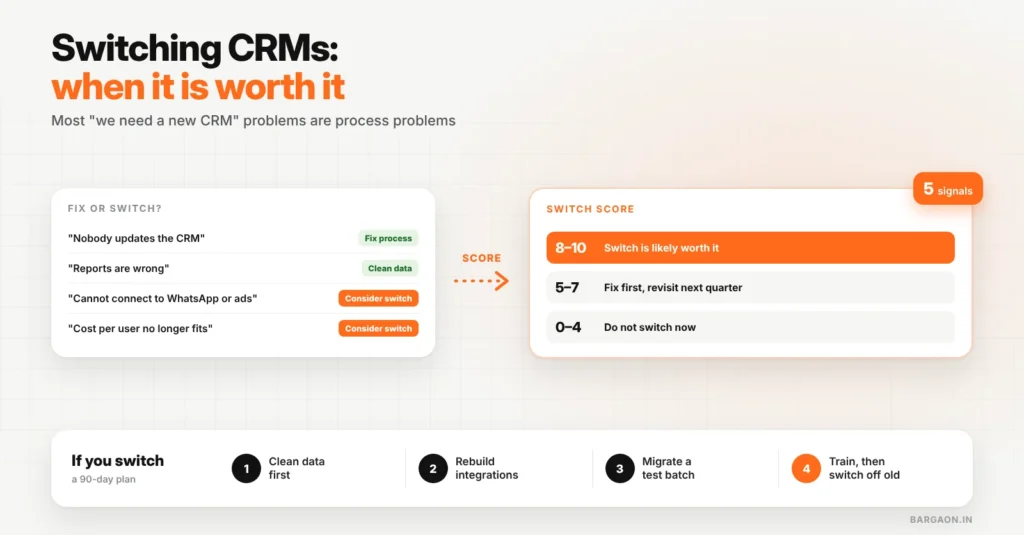
Switching CRMs is worth it when the current system blocks how you sell, not just when it feels clumsy: for example, when you cannot track leads to revenue, automate key follow-ups, connect your main tools, or the cost per user no longer fits. If the real problem is messy data, unclear stages or a team that does not use the CRM, fix that first. A new CRM will inherit the same mess.
Key takeaways
- Most “we need a new CRM” problems are process or adoption problems.
- Use the 5-signal switch score below before you sign anything.
- Count the real cost: data migration, integrations, retraining and lost momentum.
- If you switch, run it as a 90-day project with a clean-up step before the move.
If you are comparing the two most common options for Indian SMBs, see our HubSpot vs Zoho guide.
Fix or switch? Start with the real problem
| Complaint | Usually means | First move |
|---|---|---|
| “Nobody updates the CRM” | Too many fields, no clear owner | Fix: cut fields, set rules, train |
| “Reports are wrong” | Messy stages and duplicates | Fix: clean data, define stages |
| “It cannot connect to our WhatsApp or ads” | Missing integrations | Check add-ons, then consider switching |
| “We cannot see revenue by source” | Tracking gap or tool limit | Fix tracking; switch if the tool cannot do it |
| “Cost per user is too high for our team size” | Pricing no longer fits | Compare plans; switching may make sense |
The 5-signal switch score
Score each signal 0, 1 or 2
8–10: switching is likely worth it. 5–7: fix process first, revisit in a quarter. 0–4: do not switch now.
Signals 4 and 5 matter as much as the first three. A switch with dirty data and an unwilling team usually fails, whatever the new tool.
Not sure whether to fix or switch?
Tell us what is not working and we will score your CRM against the five signals.
The real cost of switching
- Data migration: contacts, deals, notes, files, email history. Some history may not move cleanly.
- Integrations: forms, ads, WhatsApp, email, accounting, website. Each needs rebuilding and testing.
- Automations: sequences, assignments and alerts must be recreated.
- Retraining: plan for a few weeks of slower selling while the team adjusts.
- Licences overlap: you may pay for both systems during the move.
If you switch: a 90-day plan
| Days | Focus |
|---|---|
| 1–30 | Clean data in the old CRM, define stages and fields, list integrations, choose the new tool |
| 31–60 | Set up the new CRM, migrate a test batch, rebuild key integrations and automations |
| 61–90 | Full migration, train the team, run both in parallel for a short period, then switch off the old one |
Our CRM implementation guide covers each step in detail.
Example (illustrative)
A Nagpur real estate developer wanted to leave its CRM because “the reports were useless”. The score was 4: the tool could do the job, but 30% of leads had no source and stages meant different things to different people. Cleaning sources and redefining six stages fixed the reports in a month, without a switch.
The Bargaon view
A CRM switch is a business project, not a software purchase. Score it honestly, fix what you can first, and if you do move, clean before you migrate. Compare options in our HubSpot vs Zoho guide, and talk to our CRM team if you want help with either path.
Get your CRM switch score
We will review your setup and tell you whether to fix or switch. See our CRM services.
FAQs
When should a business switch CRMs?
When the current CRM cannot do something your sales process needs, cannot connect to key tools, or no longer fits your budget, and your data and team are ready for a move.
How long does a CRM migration take?
For a small or mid-size team, plan for about 90 days including clean-up, setup, migration and training.
Will we lose data when switching CRMs?
Contacts and deals usually move well; activity history, files and custom automations may need extra work or may not transfer fully. Test with a small batch first.
Last updated: 11 November 2026. How we researched: Bargaon’s CRM review method described above; the example is illustrative.
Digital Marketing & SEO Specialist
Himanshu Patni has spent more than nine years in search and growth marketing, watching discovery move from ten blue links to AI answers. His work brings SEO, AEO and GEO together with paid media and measurement as one system. At Bargaon, he writes about where search is heading and what businesses should do before the shift becomes obvious.