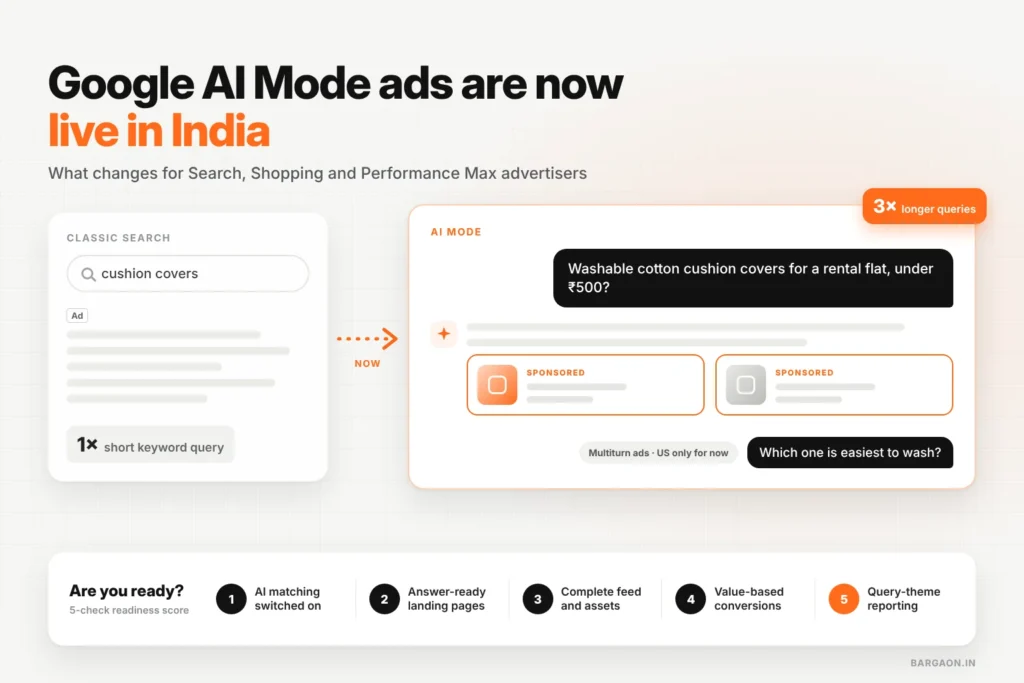
On 28 October 2026 Google said it is scaling ads in AI Mode to India and nine other countries, and launched multiturn ads (ads on follow-up questions) in the US. Indian advertisers do not need a new campaign: eligible Search, Shopping and Performance Max campaigns can serve there. What changes is how you target, write and measure.
Key takeaways
- Ads in AI Mode now reach India through existing Google Ads campaigns; there is no separate AI Mode campaign type.
- Google’s post does not announce an AI Mode reporting segment or a way to opt out of the placement, so measurement needs a workaround.
- AI Mode queries are about three times longer than classic searches (Google, US data), which rewards landing pages that answer full questions.
- Use the 5-check readiness score below before you change budgets.
What did Google announce on 28 October 2026?
In a post on its Ads & Commerce blog announcing ads in AI Mode for new markets, Google’s Shashi Thakur (VP and GM, Search Ads) said ads in AI Mode are scaling to Australia, Canada, India, Kenya, Malaysia, New Zealand, Nigeria, Pakistan, the Philippines and Singapore. Brazil, Mexico and the UK are planned for Q4 2026. In the US, Google launched multiturn ads so ads can appear on follow-up questions inside an AI Mode conversation. Ads stay labelled “Sponsored”.
Two numbers came with it. Google says AI Mode queries are on average three times longer than traditional searches (Google AI Mode Report, US, May 2026), and that click-through rates for sponsored and organic product list items in AI Mode are already similar (Google internal data, US, 20 Aug to 3 Sep 2026). Google gave no percentages for the second claim.
| Item | Status for India | What it means for you |
|---|---|---|
| Ads inside AI Mode answers | Scaling now | Your Search, Shopping and PMax ads can appear in conversational answers |
| Multiturn ads (follow-up questions) | US only | Not live in India yet; worth preparing for |
| New campaign type or budget | None announced | Placement comes through the normal auction |
| AI Mode reporting segment | Not announced in the post | You cannot see AI Mode results on their own |
| Separate opt-out | Not announced in the post | Plan as if you will be in this placement |
Why does this matter more than another ad placement?
Because the query itself changes. A classic search is a few words; an AI Mode question carries context such as budget, city, use case and constraints. Google’s ads then have to match intent, not a keyword list. That is why AI-led matching (broad match, AI Max for Search, Performance Max) matters more here than exact-match coverage.
Average query length, indexed to a traditional search
There is also a money signal. On Alphabet’s Q3 2026 earnings call, chief business officer Philipp Schindler said strong AI Mode query growth affected Search because of “lower monetization” in AI Mode, as Search Engine Roundtable reported from the earnings call. Google is adding ads to close that gap, so expect AI Mode inventory to grow, not shrink.
Who in India is affected first?
| Business type | What changes | First move |
|---|---|---|
| D2C and eCommerce | Shopping ads can sit inside product comparisons and “best for” answers | Fix feed titles, attributes and prices; check Merchant Center errors |
| B2B lead generation | Long research questions (“CRM for a 20-person sales team in Pune”) can trigger ads early in the journey | Make landing pages answer the full question; import offline conversions |
| Local businesses | Conversational “near me” style questions with constraints | Keep Business Profile, location assets and hours accurate |
Example (illustrative)
A Jaipur home-decor D2C brand runs Shopping and PMax with product titles like “Cushion Cover 16×16”. An AI Mode question reads: “washable cotton cushion covers for a rental flat, under ₹500”. Titles and attributes that state material, washability and price give Google something to match; a bare size does not.
Is your Google Ads account ready for AI Mode?
We review your campaign setup, feed and conversion tracking and tell you what to fix first.
How ready is your account? The 5-check score
This is our own scoring method. Give each check 0 (missing), 1 (partly done) or 2 (done).
Five checks before you change budgets
8–10: ready. 5–7: fix the gaps first. 0–4: start with tracking.
| Check | Done (2 points) when… |
|---|---|
| 1. AI matching | Main Search campaigns use broad match or AI Max with good negatives; PMax runs where you sell products |
| 2. Landing pages | Each key page answers who it is for, price or range, and next step in the first screen |
| 3. Feed and assets | Product titles carry material, size, use case and price; sitelinks and images are complete |
| 4. Conversions | Leads are qualified and imported back (offline conversions), not just form fills |
| 5. Reporting | You review search terms by theme weekly and track long-query share over time |
How do you measure AI Mode ads without a separate report?
Google’s post does not mention an AI Mode segment, so work with what you have. Google has also changed its help documentation so search terms from AI-powered experiences may show an interpreted query rather than the exact words typed, as Search Engine Journal reported on the search terms change. Three practical steps:
- Tag every ad with UTMs and watch long, question-style landing sessions in GA4.
- Group search terms into themes (budget, location, comparison) instead of single keywords.
- Judge AI Mode traffic on qualified leads or revenue, not clicks, using a clear attribution setup.
When should you change nothing?
If your account scores 0–4, do not raise budgets or switch on broad match yet. Without reliable conversion data, AI matching optimises towards the wrong goal. Fix tracking first; the placement will still be there next month.
Your 30-day and 90-day plan
- Next 30 days: score your account; fix conversion tracking and offline imports; rewrite the top 10 landing pages to answer full questions; clean product feed titles. Our Google Ads lead generation guide covers the setup steps.
- Next 90 days: test AI Max on one Search campaign against a control; review Performance Max and Shopping asset groups by theme; build a weekly theme report in Data Studio; prepare question-led ad copy for when multiturn ads reach India.
The Bargaon view
This is a matching and measurement shift more than a new channel. Brands that already give Google clean data, clear pages and honest conversion signals will gain the most. If you want help, our Google Ads management team works within the wider paid media setup, and you can read how AI answers choose sources in our AI search visibility guide.
Get your AI Mode readiness score from us
Share your account access and goals; we score the five checks and send a fix list. See also our Google Ads service.
FAQs
Do I need a new campaign to show ads in AI Mode in India?
No. Google says existing eligible campaigns serve there through the normal auction. Search with broad match or AI Max, Shopping and Performance Max are the relevant types.
Are multiturn ads live in India?
Not yet. As of the 28 October 2026 announcement they launched in the US only. Google has not given an India date.
Can I see AI Mode performance separately?
The announcement does not mention a separate report. Use search-term themes, UTMs and qualified-conversion data to judge impact.
Sources
- Google: Ads in AI Mode expand to new markets (28 Oct 2026, checked 4 Nov 2026)
- Google AI Mode Report, US (May 2026, linked from Google’s post)
- Google Ads Help: ads in AI-powered experiences in Google Search (linked from Google’s post)
- Search Engine Roundtable: earnings call comments on AI Mode monetization (29 Oct 2026)
- Search Engine Journal: search terms for AI queries (2026)
Last updated: 4 November 2026. How we researched: Google’s official announcement and linked documentation (checked on 4 November 2026), plus attributed industry reporting on the Q3 2026 earnings call.
Digital Marketing & SEO Specialist
Himanshu Patni has spent more than nine years in search and growth marketing, watching discovery move from ten blue links to AI answers. His work brings SEO, AEO and GEO together with paid media and measurement as one system. At Bargaon, he writes about where search is heading and what businesses should do before the shift becomes obvious.