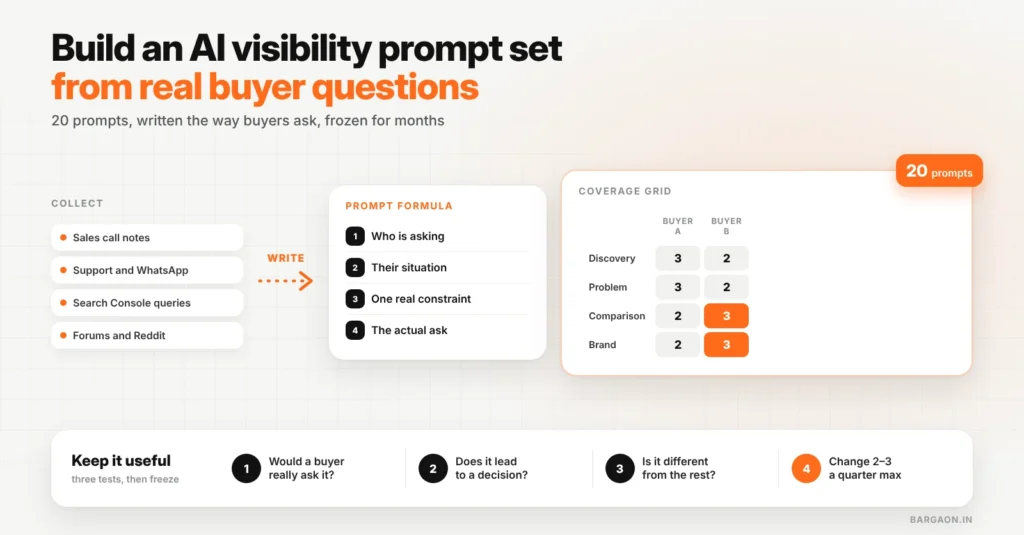
An AI visibility prompt set is a fixed list of around 20 questions your buyers really ask, written the way they ask them, that you run in ChatGPT, Perplexity and Google’s AI answers every month. Build it from real buyer language (sales calls, support tickets, Search Console queries, forums), cover each stage of the buying journey, and change no more than a few prompts a quarter so results stay comparable.
Key takeaways
- Your prompt set is the ruler for AI visibility. A bad ruler gives confident but useless numbers.
- Take prompts from real buyer words, not from your keyword list.
- Use a coverage grid: four question types across your main buyer types, so no stage is left out.
- Version the set. Swap at most two or three prompts a quarter, and log every change.
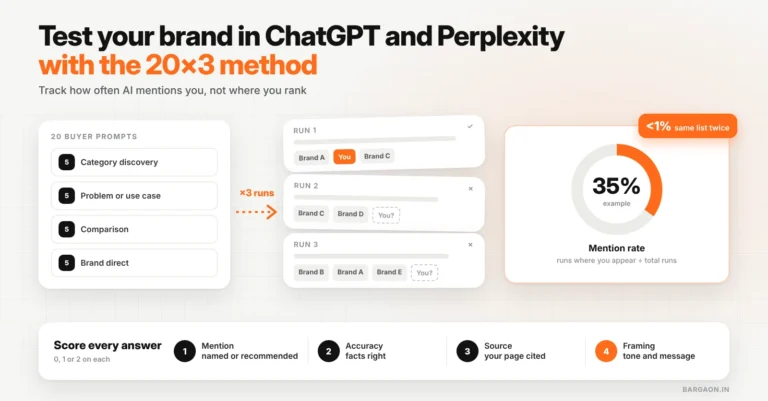
This post goes one level deeper than our 20×3 brand check: that post shows how to run and score prompts, this one shows how to write them. For the full measurement picture, see our AI search visibility tracking guide.
Why the prompt set matters more than the tool
AI answers vary from run to run; a 2026 SparkToro and Gumshoe.ai study found brand lists almost never repeat for the same prompt, as Search Engine Land reported. That makes the prompt list the one stable part of your measurement. If it is built from what you want to rank for rather than what buyers ask, every report after it measures the wrong thing.
Step 1: collect real buyer questions
| Source | What to pull | Why it helps |
|---|---|---|
| Sales call notes | The first question a prospect asked | Shows how buyers frame the problem before they know you |
| Support tickets and WhatsApp chats | “Can it…”, “does it work with…” questions | Gives real constraints: budget, size, tools, location |
| Search Console queries | Long queries with 6+ words | Already close to how people phrase AI prompts |
| Forums and Reddit threads | Recommendation requests in your category | Shows how buyers compare options in their own words |
| Competitor reviews | What reviewers say they were looking for | Surfaces needs you may not be naming |
Aim for 60 to 80 raw questions. You will cut them down to 20.
Step 2: write each prompt with the 4-part formula
Who + situation + constraint + ask
“I run a 40-bed hospital in Indore (who + situation). We use Excel for appointments and have no IT team (constraint). Which clinic software should we look at? (ask)”
Short keyword-style prompts (“best clinic software India”) are worth keeping as a small control group, but most of your set should read like a real person typing a full question.
Is your page ready to answer these prompts?
Run your main service page through the Answer Readiness Checker to see if AI tools can quote it.
Step 3: fill the coverage grid
Pick your two or three main buyer types and make sure each one has prompts at every stage. A simple grid for a B2B software firm with two buyer types:
| Question type | Buyer A: operations head | Buyer B: founder |
|---|---|---|
| Category discovery | 3 | 2 |
| Problem or use case | 3 | 2 |
| Comparison | 2 | 3 |
| Brand direct | 2 | 3 |
If one cell is empty, you have a blind spot. If one cell has eight prompts, it will dominate your mention rate and hide everything else.
Step 4: cut to 20 with three tests
- Would a real buyer ask this? If it only exists because you want to rank for it, drop it.
- Does it lead to a decision? Prefer questions that end in a choice or a shortlist over pure definitions.
- Is it different from the others? Two prompts that differ by one word measure the same thing twice.
Example (illustrative)
A Jaipur interior design studio started with 70 questions from WhatsApp enquiries. After the three tests, 20 remained: six about budget (“2BHK interiors under ₹8 lakh”), five about timelines, five comparisons with local studios and four brand questions. Its first run showed it was named in brand questions but almost never in budget questions, which became the first content fix.
Step 5: version and maintain the set
- Keep the set in a sheet with a version number, a date and the reason for each prompt.
- Change at most two or three prompts a quarter. More than that and month-on-month trends stop meaning anything.
- When you launch a new service or enter a new city, add a small separate set for it rather than editing the core 20.
The Bargaon view
Most AI visibility work fails at the prompt list, not at the tool. Spend an afternoon collecting real buyer questions, fill the grid, cut to 20 and freeze it. Then run it with the 20×3 method and track mention rate over time. Our AI visibility tracking guide covers the reporting side, and our GEO service can build and run the set with you.
Make your key page easy for AI to quote
Check one page now, then see our GEO service for help building your prompt set.
FAQs
How many prompts should an AI visibility prompt set have?
Around 20 is a practical start for one brand and one market. Add separate small sets for new services or cities instead of growing the core set.
Should prompts include my brand name?
Only in the “brand direct” group, about a quarter of the set. The rest should be unbranded, because that is where you learn whether AI recommends you to people who do not know you yet.
How often should I change the prompt set?
Rarely. Swap two or three prompts a quarter at most and log the change, so monthly results stay comparable.
Sources
- Search Engine Land: AI recommendation lists repeat less than 1% of the time (2026, on the SparkToro and Gumshoe.ai study)
Last updated: 8 November 2026. How we researched: published reporting on AI answer consistency, plus Bargaon’s own prompt-building method described above.
Digital Marketing & SEO Specialist
Himanshu Patni has spent more than nine years in search and growth marketing, watching discovery move from ten blue links to AI answers. His work brings SEO, AEO and GEO together with paid media and measurement as one system. At Bargaon, he writes about where search is heading and what businesses should do before the shift becomes obvious.