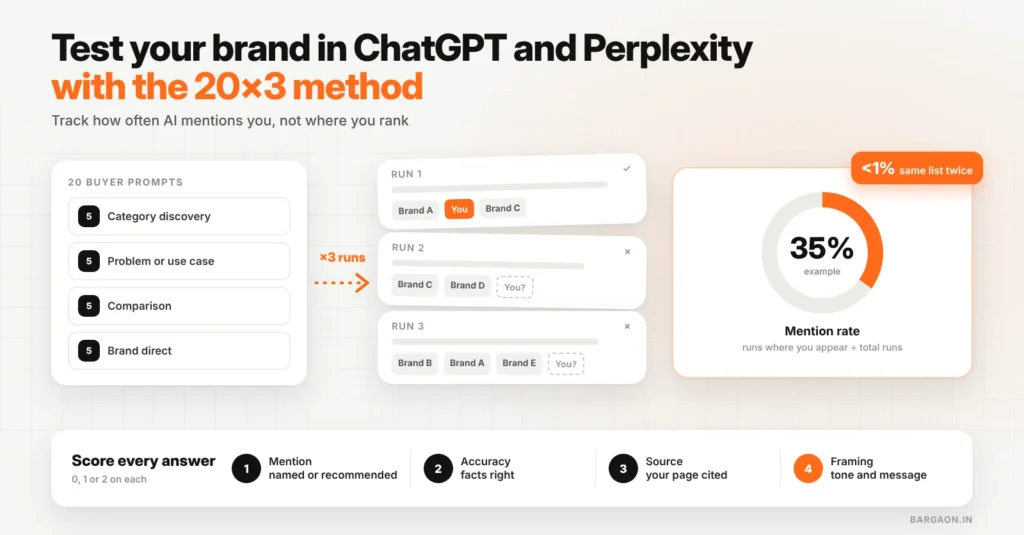
To test your brand in ChatGPT and Perplexity by hand, run a fixed set of 20 buyer questions, three times each, in a clean logged-out session, and log whether you are mentioned, whether the facts are right and which sources are cited. Track your mention rate over time, not your position in the list. AI answers change too much from run to run for rank to mean anything.
Key takeaways
- AI recommendation lists almost never repeat: a 2026 SparkToro and Gumshoe.ai study found less than a 1-in-100 chance of getting the same brand list twice.
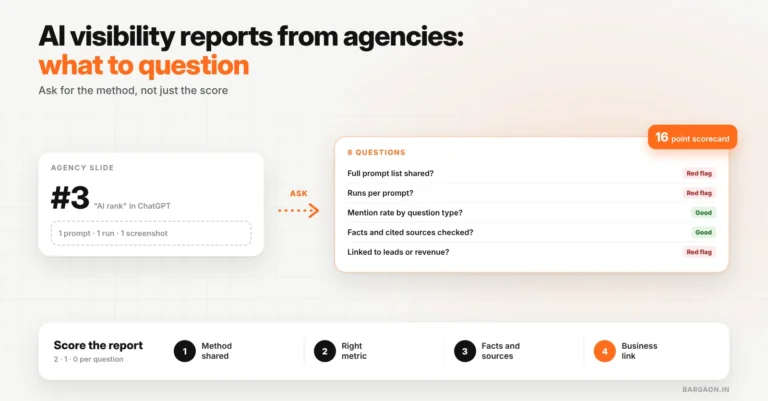
- That makes “we rank #2 in ChatGPT” a weak claim. Mention rate across many runs is the number that holds up.
- Our 20-prompt, 3-run method takes about two hours a month and needs only a spreadsheet.
- Perplexity shows its sources, so it tells you why you are missing. Use it to find the pages and sites to fix.
This post is the hands-on companion to our B2B GEO and AI search visibility guide. The guide covers why AI engines pick some brands; this post shows how to check, without paid tools, whether they pick yours.
Why a single test in ChatGPT tells you almost nothing
Most teams test once: they type “best [category] in [city]” into ChatGPT, see the answer and either relax or panic. The problem is that AI answers are generated fresh each time. In a study run by Rand Fishkin of SparkToro and Patrick O’Donnell of Gumshoe.ai, 600 volunteers ran 12 prompts nearly 3,000 times across ChatGPT, Claude and Google’s AI. The lists varied in length, brands and order, as Search Engine Land reported on the study.
The useful finding is in the same study: the intent behind answers stayed consistent even when the lists changed. So the right question is not “where do we rank?” but “how often do we show up when buyers ask this kind of question?”
What a single test hides (illustrative)
The Bargaon 20×3 AI brand check
This is our own method. It is built to be repeatable by one person in about two hours a month.
Four steps, once a month
20 prompts × 3 runs × 2 tools = 120 answers a month.
Step 1: write 20 prompts in four buckets
| Bucket | What it tests | Example prompt |
|---|---|---|
| Category discovery | Do you appear when buyers do not know you yet? | “Which HR software works well for a 200-person company in India?” |
| Problem or use case | Are you linked to the problem you solve? | “How can we cut payroll errors across three states?” |
| Comparison | How are you described against rivals? | “[Your brand] vs [competitor]: which is better for mid-size firms?” |
| Brand direct | Are the facts about you right? | “What does [your brand] cost and who is it for?” |
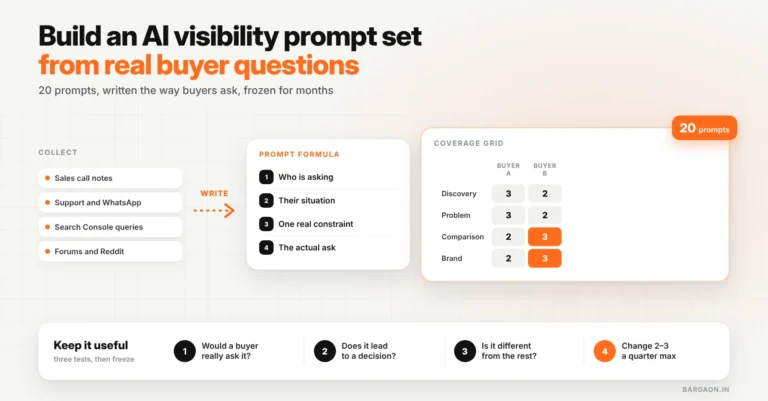
Write prompts the way buyers talk: full sentences, with company size, city or budget. Keep the same 20 every month so results stay comparable.
Step 2: run each prompt three times in a clean session
- Use a logged-out or incognito window, or turn off memory and personalisation, so past chats do not bias the answer.
- Start a new chat for every run. Note the date, the tool and whether web search was on.
- Run in both ChatGPT and Perplexity. Perplexity always shows its sources; ChatGPT shows them when it searches the web.
Step 3: score four things per answer
| Measure | 0 | 1 | 2 |
|---|---|---|---|
| Mention | Not named | Named in a list | Recommended or described in detail |
| Accuracy | Wrong facts (price, location, offer) | Partly right | Correct and current |
| Source | No source about you | Third-party source only | Your own page cited |
| Framing | Negative or outdated | Neutral | Positive and on-message |
Your headline number is the mention rate: runs where Mention is 1 or 2, divided by total runs. Report it per bucket. A brand at 70% for “brand direct” but 10% for “category discovery” has a very different problem from one that is wrong about its own pricing.
Check if your pages are ready to be cited
Our Answer Readiness Checker scores a page on the things AI engines need to quote it: a clear answer, structure and facts.
Step 4: fix the biggest gap first
| Weak score | What it usually means | First fix |
|---|---|---|
| Low mention in category discovery | Few independent sites list you | Get onto the comparison pages, directories and forums Perplexity cites for that query |
| Low accuracy | Old or unclear facts about you online | Put price range, locations and who you serve plainly on your site; update listings |
| Source = 0 or 1 | Your pages are not easy to quote | Add answer-first summaries and FAQs; check AI crawlers can reach the site with our AI crawler checker |
| Negative framing | Reviews or old articles dominate | Answer the criticism on your own pages and respond to reviews |
Example (illustrative)
A Pune payroll software firm scores 80% mention rate on brand-direct prompts but 8% on category discovery. Perplexity’s sources for the category prompts are three “best payroll software in India” lists and two Reddit threads, none of which name the firm. The fix is outreach to those lists and a useful reply in the threads, not another blog on its own site.
When is a manual check not enough?
Once you track more than about 50 prompts, several markets or many competitors, a spreadsheet gets slow. That is the point to look at tracking tools, which run prompts at volume. Even then, judge them on mention rate across many runs, not on a single “AI rank”. Our AI search visibility tracking guide covers what to measure, and how to get visible in ChatGPT and Perplexity covers the fixes in depth.
The Bargaon view
AI visibility is a share-of-answers game, not a ranking game. Twenty good prompts, run three times and scored honestly, will tell you more than a dashboard showing one position. Start with the check above, fix the biggest gap, and repeat monthly. For the full strategy, return to our B2B GEO guide, or see how our generative engine optimization service runs this at scale.
Make your key pages easy for AI to quote
Run your top service page through the Answer Readiness Checker, then see our GEO service if you want help fixing the gaps.
FAQs
How often should I test my brand in ChatGPT and Perplexity?
Once a month is enough for most brands. Use the same prompts each time so changes in mention rate reflect real shifts, not new questions.
Why run each prompt three times?
AI answers change from run to run. Three runs per prompt, across 20 prompts, gives 60 answers per tool, which is enough to see a pattern rather than one lucky or unlucky answer.
Should I test logged in or logged out?
Logged out, or with memory and personalisation turned off. Your own chat history can make the AI more likely to mention your brand, which hides the real picture.
Sources
- Search Engine Land: AI recommendation lists repeat less than 1% of the time (2026, on the SparkToro and Gumshoe.ai study)
- Search Engine Journal: AI recommendations change with nearly every query (2026)
Last updated: 5 November 2026. How we researched: published reporting on the SparkToro and Gumshoe.ai consistency study, plus Bargaon’s own testing method described above.
Digital Marketing & SEO Specialist
Himanshu Patni has spent more than nine years in search and growth marketing, watching discovery move from ten blue links to AI answers. His work brings SEO, AEO and GEO together with paid media and measurement as one system. At Bargaon, he writes about where search is heading and what businesses should do before the shift becomes obvious.